Disclaimer: I would like to formally thank Jack from Apos Audio for providing us with two units in exchange for an impartial and honest review, despite the lengthy delay. On behalf of the team at the Headphone List, we thank Campfire Audio for their generosity and trust in THL.
Summary
The Druid is an accessible, entry-level DAC without the cost prohibitions of typical ‘R2R’ DACs. Its fundamental ‘character’ is syrupy, saturated in lower-mid warmth. Note strikes are extremely rounded and contoured with a smooth, bouncy timbre.
However, its polarising ‘even-harmonic’ bias and edgeless presentation may prove contentious to treble-lovers or fans of neutrality, with R2R topologies notorious for higher levels of distortion.
Score
8/10 – Build Quality
8/10 – Sound
Pros:
+ Even-harmonic saturated timbre with analog overtones
+ Exceptional dynamics and holographic-like separation
+ Affordability and swappable operational amplifier (OP amp) output stages.
Cons:
– Lack of input/output versatility on the Druid
– DIY aesthetic and exposed circuitboard
– Polarising timbre (neutral, it is not)
Introduction
Apos Audio is an American audiophile distributor, specialising in curating and selling portable audio peripherals, headphones, and IEMs for a thriving community of like-minded enthusiasts. But they are far from an ordinary storefront.
Apos Audio also runs a community-driven program, ‘Apos X’, collaborating with other bespoke brands to showcase novel design concepts to the public. If enough people express their interest in the form of a ‘newsletter signup’, these projects move from ideation to reality. It’s a win-win way for Apos to correctly allocate resources to the right projects.
One such successful project is the Apos Gremlin and Merlin, a tube amplifier and DAC stack duo that was released to popular fanfare — all for $280. Equipped with Rayheon tubes and an AKM4993 DAC, respectively, the value proposition is undeniable.
Today, we’re reviewing a DAC adjacent to this latest release, the Druid. Designed to be used in conjunction with the Gremlin, the Druid shares the same dimensions, same acrylic chassis and same design language. The unique selling point here is its fully-discrete R2R DAC topology with swappable op-amps for $160.
On the surface, that’s a flat-out bargain compared to higher-end R2R options on the marketplace (think the Holodac, for instance). But the proof is in the ‘sonic pudding’, not what its spec sheets say.
The Apos Audio Druid can be purchased via the links below:
Unboxing
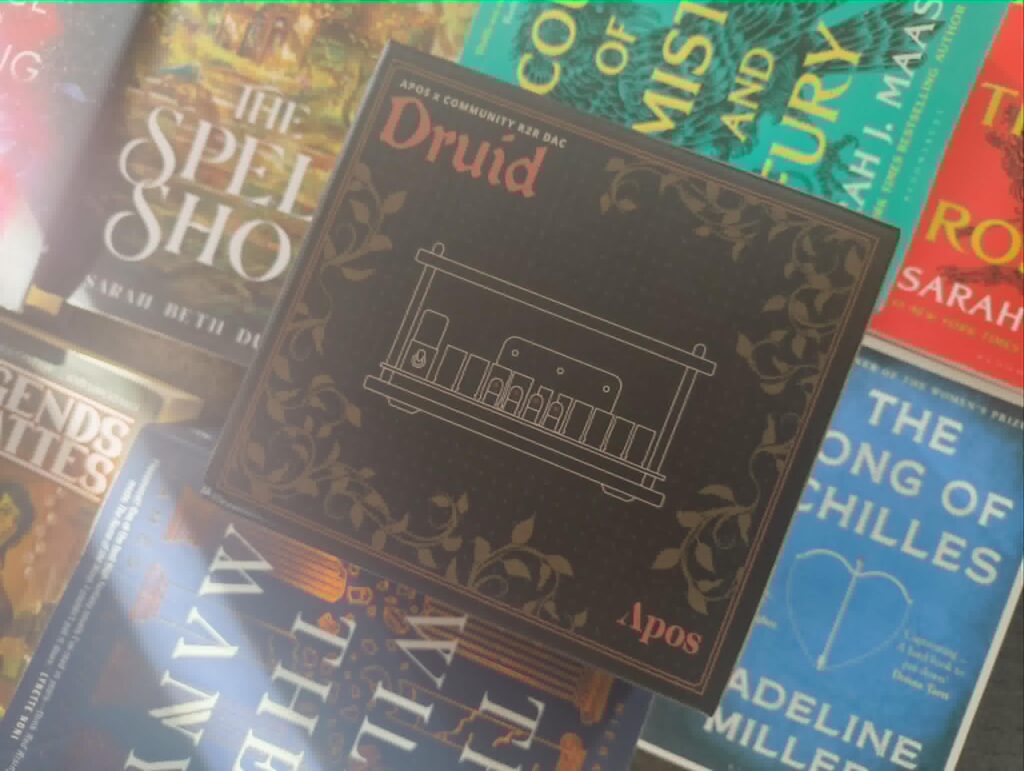
If you’ve seen my Gremlin and Merlin reviews, then you can expect no different here. The Druid comes shipped in the same cube-shaped cardboard box, generously embellished with sepia-toned typography with bold, wizard-like serif flourishes. It’s very on-brand with the obvious ‘saxon’ mythology-type aesthetic Apos is going for.
Inside the box, you’ll find the following accessories:
- The Druid
- Apos Audio-branded vinyl stickers
- Instructions
- Powerbrick
- USB-C to USB-C cable
- 3.5mm to RCA receiver (female)
- Pliers (for removing op-amps).
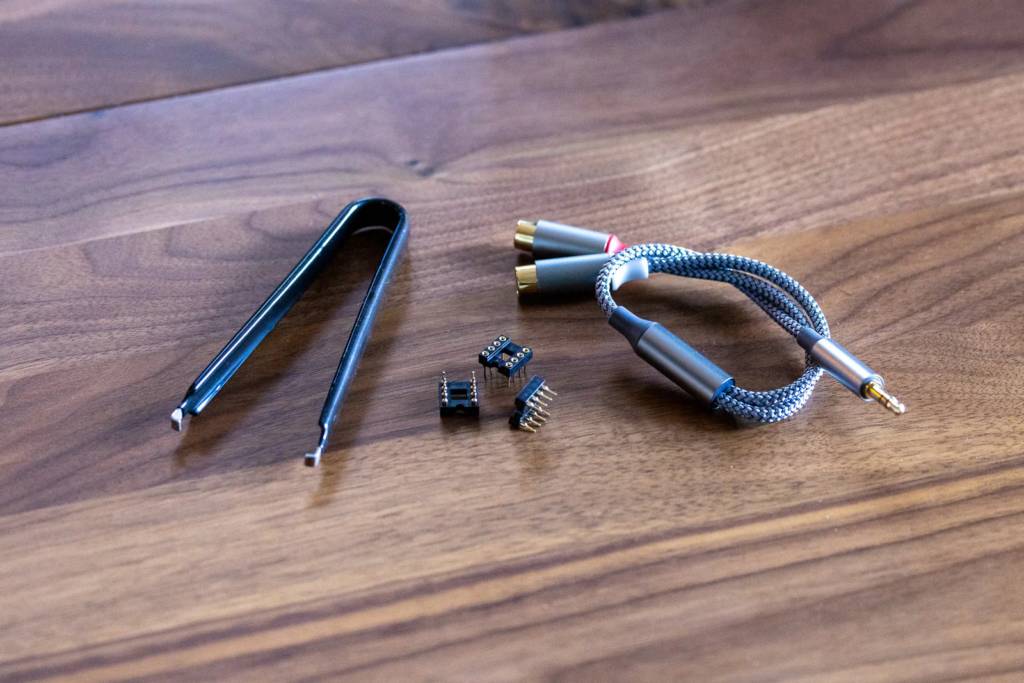
You’ll not find yourself wanting – apart from the lack of an XLR-XLR balanced interconnect (which I complained about in the Gremlin/Merlin review), you should have everything you need to get started.
Design and durability
The Druid is reminiscent of ‘Raspberry PI’ DIY assembly kits. Everything is see-through, with its circuitry laid bare for the enthusiast. You can see the Druid’s series of resistors wired in parallel, followed by its swappable op-amp stage.
The plinths in which the circuits sit are fabricated from 1mm thick (as per my eyeballs if they don’t fail me) acrylic. The aluminium pillars that hold everything together are rock-solid and reliable.
If you’re fascinated by what’s hidden beneath your DAC’s hood, the Druid provides you with a first-row seat to its nuts and bolts — the engine that attempts to replicate an analog waveform. While its homebrew aesthetic has its appeal, I prefer it to be fully encased or shrouded in metal. Out of sight, out of mind.
My biggest grievance is that its exposed innards are a dust magnet. For someone with mild OCD, this is a big hiccup for me. Apart from that, the Druid is highly reliable and should withstand a few scrapes on the desk.
Turn to the next page for ‘Features’