Design and fit
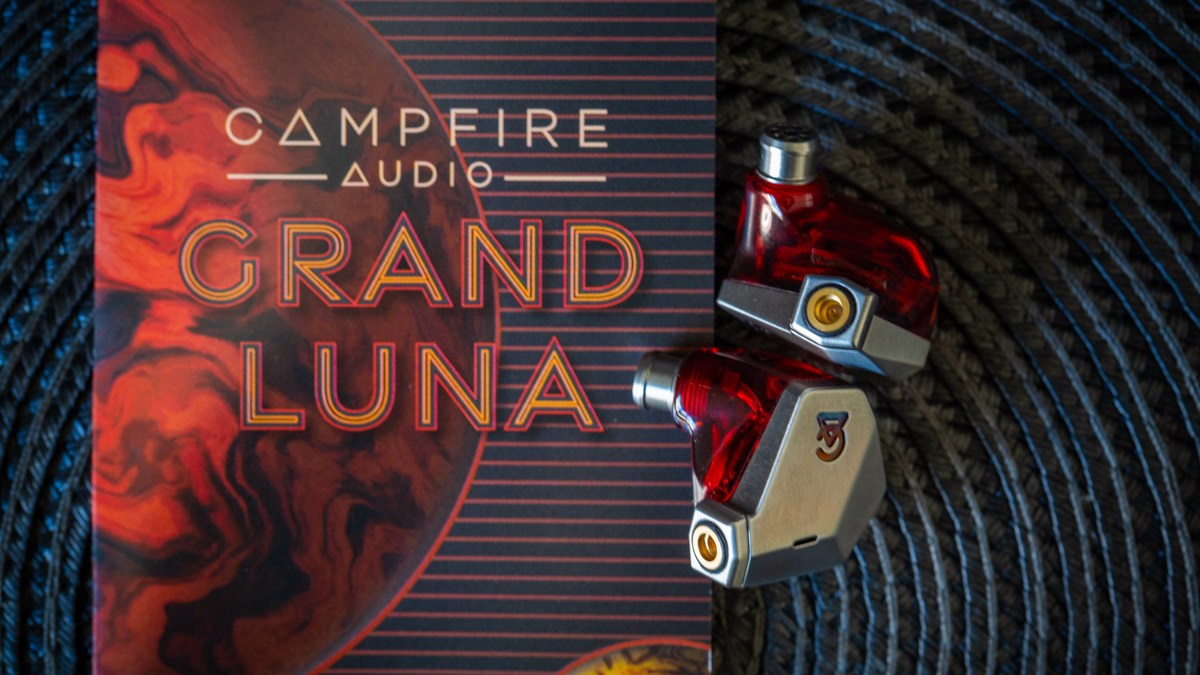
Grand Luna’s styling is based on the typical Campfire resin housing with metal face cap template, but mixes it up with some unique touches of its own.
For starters, the main shell is made from an internally red-hued translucent casing that illuminates the large planar and dual BA drivers, sound tubes, and other electronics inside. We’ve seen similar translucent treatment in both Astrolith and Clara, but the latter two are, in my opinion, more nuanced, sleeker in their curvature, and far more jewel-like.
You’d think a red version of that would give off ruby stone vibes, but instead, Grand Luna’s clear red shells look and feel more like this:

Before you start shouting at your screens to protest the Lego analogy, I’ll add that it’s all very well put together, as you’d expect from a Campfire IEM, especially in combination with the hand-brushed stainless steel and burned logo face cap, but it just doesn’t have the same sophisticated feel I got from Astrolith’s chrome and tinted black housing, or Clara’s deep black and crystalline blue orbs.
Size-wise, Grand Luna is closer to Astrolith than Clara. The shells are nice and light, despite their solid construction, but the thicker metal nozzles will challenge those with small ear canals to find suitably small and soft tips for a comfortable fit. While the included foam tips are an option for those with smaller ears, if you’re just as averse to those as I am, try a size down of your favourite tips if you find yourself struggling with the nozzle size.
Overall, Grand Luna is a very smart piece of IEM engineering, and you can see that time and effort have been put in to putting it all together. It must be a pleasure to have such a large repository of materials, designs, and fabrication techniques to call on, keeping production values high and quality consistent from one IEM to the next, and Grand Luna is yet another example of the process at work.
Despite some of my personal misgivings about its plastic-like appearance, I can’t deny that Grand Luna fits right in the pocket of Campfire’s quirky design language.

Tech and specs
Grand Luna is the first Campfire IEM to feature a hybrid planar driver set, in this case a new-generation 14mm planar magnetic driver for lows and midrange, supported by dual custom BA drivers for highs.
The driver array is set into what Campfire calls its Additive Acoustic Optical inclusion (AAOI) housing, which is basically a precision 3D-printed cavity that helps shape the tonal output of the drivers and prevent resonance and other unwanted artefacts in the sound path.
I’ve really enjoyed walking the path of Campfire’s planar technology; in fact, my very first experience of a planar IEM was the single planar Supermoon (reviewed here), followed by the dual-planar Astrolith, and now the planar hybrid Grand Luna. In each case, I’ve heard both an evolution and devolution of Ken’s take on planar tuning, from the detailed but occasionally spritely and metallic Supermoon, to the brilliant, bold, and borderline bright Astrolith.
Grand Luna is very different to both, as you’ll read shortly, but it also shares some of the inherent characteristics of the planar lineage in terms of speed and extension – and flaws.

The choice of balanced armatures for the highs is one I was very much looking forward to, given my patchy experience with planar tweeters to date. I always seem to find niggles with planar treble, be it too much zing, a metallic sheen, or a random peak that always shows up at the most inopportune moments.
While that’s a grand generalisation (excuse the pun), I do tend to prefer the more natural nature of BA treble, with little to no compromise in speed or detail. In fact, Campfire reckons that Grand Luna’s tweeters can hit highs of 30KHz, way beyond the ability of human hearing, but whether they can pull off a gentler, more refined tuning will be the litmus test for my ears.
Ultimately, what’s going to make the blend of these different drivers work together is not their potential on paper, but rather how well they’ve been implemented, tuned and balanced against each other’s’ strengths and weaknesses, and that’s what we’ll look at next.
Technical specs
- Drivers: 14mm next-generation planar (bass/mids); 2x custom BA (treble)
- Housing: resin shell (dyed/translucent), hand-forged stainless steel face cap
- Connectors: beryllium-coated copper MMCX
- Impedance: 13Ω
- SPL: 94db @ 1 kHz (33 mVrms)
- Frequency Response:5Hz -30kHz
- Total Harmonic Distortion: < 0.5%

Continue to sound impressions…